

Thirteen years ago, the US Food and Drug Administration made a remarkable announcement: the recommended dose of a widely used sleeping pill should be cut in half for women.
The drug was zolpidem, better known by the brand name Ambien.
The reason was startling. After the medicine had been on the market for nearly twenty years, new evidence helped the FDA establish the risk: women cleared it from their bodies more slowly than men. A pill taken at bedtime could leave enough medication in their blood the next morning to impair driving even when they felt fully awake.
What interests me is what this revealed about the way we understand patients. The same medicine, at the same dose, could leave women and men facing different risks the following morning.
Recognising that difference changed prescribing. But it also raises a wider question: what else could we do differently if we understood the patient better?
It takes hours each week to research, write, and produce at this level. Consider becoming a free or paid subscriber to support my work. Thank you.
Sex is one part of that understanding. Another is biological time: how the same woman’s biology and healthcare needs can change through puberty, pregnancy, perimenopause and postmenopause. Healthcare has to recognise both who she is and what is changing.
I explored this in Why Women’s Health Is the First Test of Precision Health.
Why Women's Health Is the First Test of Precision Health

Every healthcare system is built on assumptions. The most consequential ones are often the hardest to see.
We count our lives in years, but a birthday tells us only so much. Biological transitions can change the context in which symptoms, risks and treatment decisions need to be understood. Our history matters too: something that happened during pregnancy may carry information relevant to health years later.
Women’s health makes these connections visible. It asks us to look more closely at differences between women and men, changes within the same woman over time, and the experience of living with a condition.
That last part matters. Understanding a patient includes understanding what she needs from care: symptoms taken seriously, treatment she can manage, and appointments and services she can access alongside the demands of everyday life. Those experiences help define what a better solution needs to deliver.
When we understand a need more clearly, we can see what existing care is missing and what a business could do better.
That is the connection I am interested in as an investor. Better understanding can open the way to a more useful test, a more effective treatment or a service that reaches people existing care has struggled to serve. A company that delivers that improvement may build a lasting business around it.
I call that potential The Precision Premium.
What is the Precision Premium?
The Precision Premium is the potential value created when a more precise understanding of biology, clinical needs and lived experience leads to better healthcare and durable businesses.
I coined the term to give this investment conviction a clear expression.
“Precision” can sound highly technical. It can bring to mind gene sequencing, sophisticated diagnostics or individually tailored treatments. Those are part of the opportunity. But the idea reaches further: understanding a meaningful difference well enough to act on it.
With zolpidem, the action was a change in dosing. Elsewhere, better understanding may enable a new diagnostic, a treatment, a device or a different way of delivering care.
Women’s health is a leading edge of this broader healthcare transition. The opportunity spans both conditions specific to women and the ways women experience diseases that affect both men and women.
For me, the investment question is: which businesses can turn that understanding into an improvement people will use and pay for?
A test has to help someone make a decision. A treatment has to offer a meaningful benefit. A care service has to fit into people’s lives. Each needs a credible route into use.
After more than two decades investing over $100 billion of client capital, I pay close attention to those connections. They determine whether an important idea can support a lasting business.
The benefits may accrue to different people. A patient may gain a better treatment choice. A hospital may avoid unnecessary costs. The company supplying the solution still needs a viable way to be paid. Understanding where value is created and how it is captured is part of the investment work.
That is what “premium” means in this thesis: the potential value unlocked by better understanding and effective action. Whether it becomes an attractive investment depends on the business, the risks and the price paid.
To make that thinking practical, I have developed The Precision Premium framework:
Need → Insight → Solution → Adoption → Value.
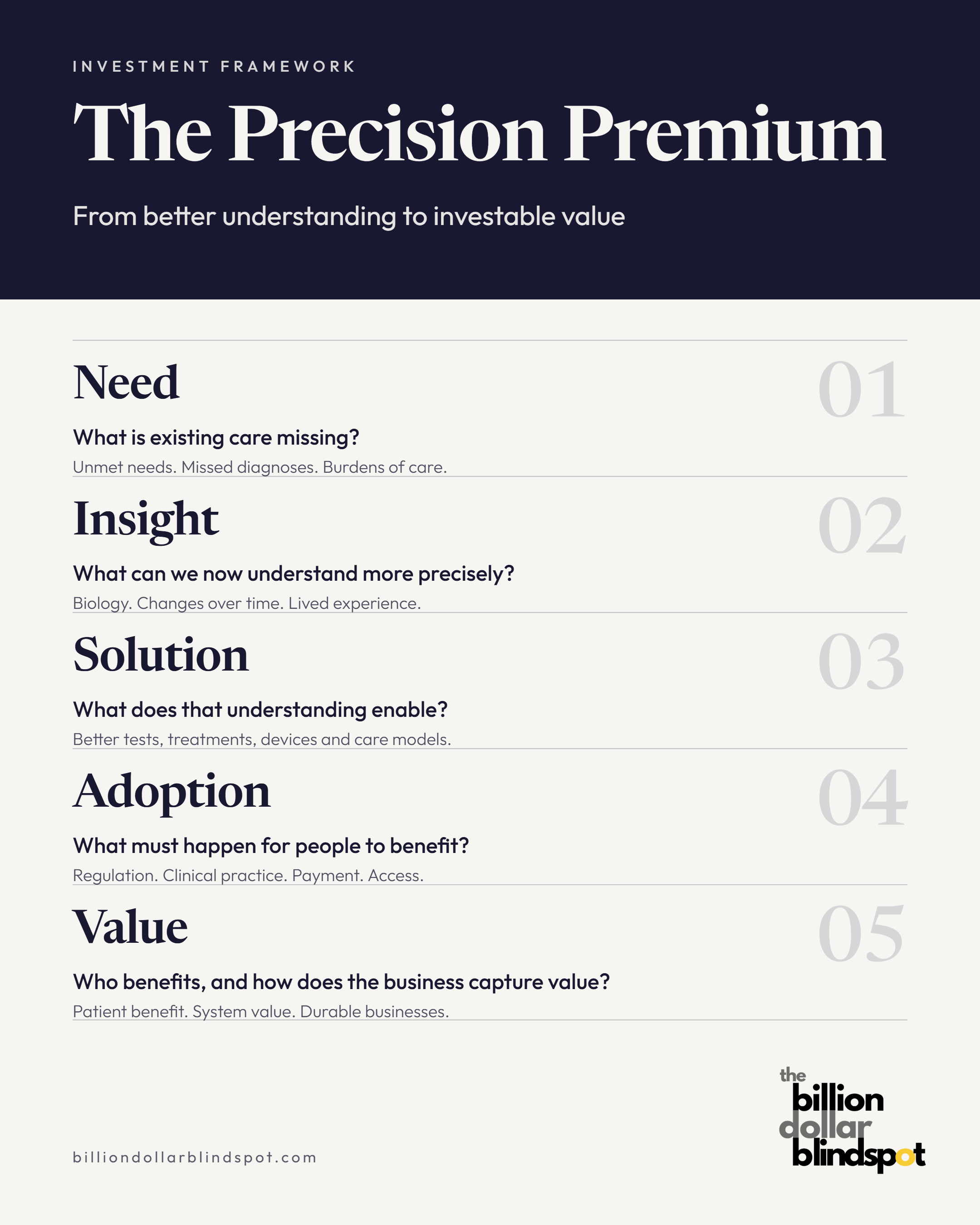
It follows the opportunity from what existing care is missing through to how a business can deliver and sustain an improvement.
I have published the full Precision Premium essay and framework on Billion Dollar Blindspot, bringing together the evidence, examples and questions behind the thesis.
The zolpidem story began with a medicine that was already widely used. Understanding a difference between patients changed how it should be prescribed. But there is still a lot of white space within women’s health to transform better understanding of the female biology into better care.
That is where I see the potential for The Precision Premium.
My new book, The Billion Dollar Blindspot is now available on Amazon and in bookstores.

About Maryann Selfe
Maryann Selfe is an institutional investor and the Founder and Chief Investment Officer of Calabar Capital, an investment platform backing exceptional managers and founders in women’s health. She is the author of The Billion Dollar Blindspot and writes about women’s-health investing and capital allocation.
Connect on LinkedIn · Discover the Book · Learn more about Calabar Capital
The Billion Dollar Blindspot is an independent publication. Its content is provided for informational and educational purposes only and does not constitute financial advice, an investment recommendation or an offer to buy or sell any security.