

“Does anyone else take a lot of pills?” a woman asked in an online menopause forum. She then proceeded to list the six supplements she was already taking, and the three she’d just been advised to add.
Another woman replied that she doubted most of her supplements were doing much but she took them anyway because her doctor had recommended them, and this was the doctor who, she said, had been willing to prescribe HRT after she’d had breast cancer.
“I don't think most of the supplements are helpful or needed, but I'm doing what she asks because she's willing to prescribe HRT for me, a breast cancer survivor.”
Join me live on YouTube every Sunday at 7pm CET.
The Billion Dollar Blindspot exists to help make sense of what’s changing in women’s health. Becoming a founding member is a way to support that work and help bring these important stories to a wider audience.
On paper, she could have weighed each recommendation separately. What was the zinc for? Did she need the magnesium?
Reading her reply, I got the sense that she was weighing something else alongside the pills. She’d found a doctor who had helped her with something that mattered to her. That experience gave the doctor’s other recommendations weight.
But if you are standing in a shop with two bottles labelled menopause support, you have a lot less to go on. What would you expect one bottle to do that the other couldn’t?
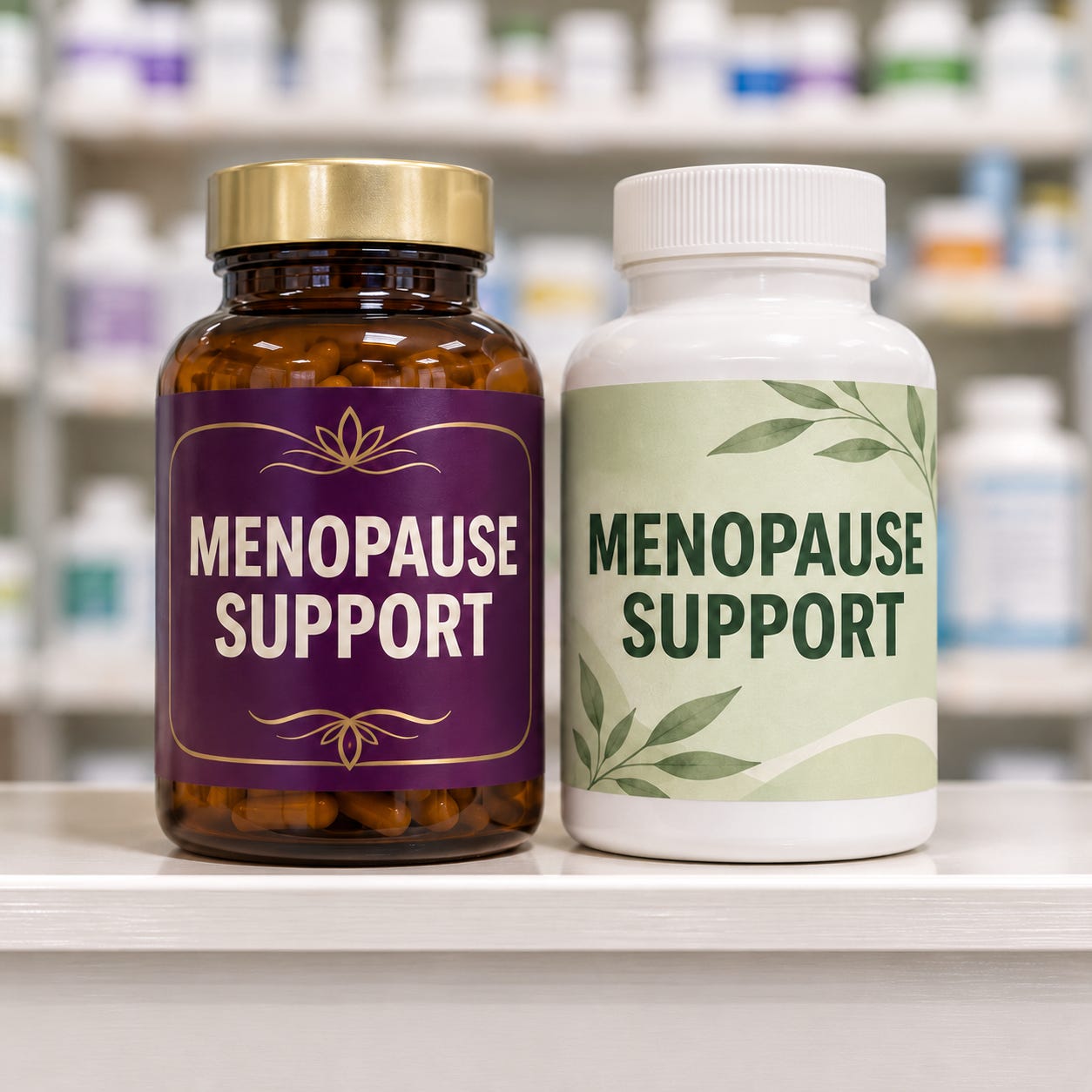
In September 2026, Poppy Sullivan and her colleagues reported in Climacteric that they’d identified 201 menopause supplements available to buy in the UK. The ingredients varied widely, with no single ingredient common to all 201.
That same month, The Guardian reported on a Which? investigation into 26 supplements marketed to women in midlife. Some supplements cost more than £400 a year while a supermarket multivitamin in the comparison cost £22.
The price gap is more obvious than what the extra money is supposed to buy you.
Even when you know the ingredient, it helps to know what the researchers measured.
A 2013 Cochrane review found a possible reduction in hot flushes in four trials of extracts high in genistein, one of the compounds in soy, and called for more research.
While a 2025 review found a small improvement in overall menopause symptom scores with soy isoflavones, but no clear benefit for hot flushes.
So if hot flushes are what brought you to that shelf, seeing “soy isoflavones” on the label tells you what’s in the bottle. You’re still left with the question you came in with. “Will this do anything for my hot flushes?”
I once heard of a judge who sat through a hot flush in a court in session, fully dressed in her legal attire.

If one has ever lived through a hot flush, one might understand why she might have wanted something to alleviate her symptom right there and then, without leaving her chair.
And that’s a very particular problem to design for.
The Embr Wave is a wristband that applies a cooling or warming sensation to a small area of skin. You can switch it on while you’re still sitting there.
In a pilot study described by Embr Labs, ten women reported that hot flushes interfered less with daily life after using the device. (the study had no comparison group, so it’s hard to know how much of that improvement came from the wristband.)
By November 2026, nearly a quarter of a million devices had been sold across two generations, according to Therabody, which bought the intellectual property behind the wristband.
Therabody is best known for the Theragun. The company behind the massage gun now owns technology developed in part to help women through a hot flush, and it has said menopause is where it plans to build on that work first.
With a prescription medicine, there’s a further question. Can your doctor prescribe it where you live?
Take Bijuva, a menopause hormone therapy that combines oestradiol and progesterone in one capsule. It went on sale in the US in April 2019. That June, Theramex licensed the rights to sell it in markets including the UK, where it launched as Bijuve in September 2021.
The same capsule reached those two markets more than two years apart.
That’s the business Cinven agreed to buy in November 2026. Theramex develops, licenses and sells medicines for contraception, fertility, menopause and osteoporosis. It operates in more than 80 countries.
In announcing the deal, Cinven pointed to the company’s track record of licensing medicines developed elsewhere and bringing them to market. The Financial Times reported that the deal valued Theramex at about €2.6 billion.
You may never care what multiple Cinven paid for Theramex. But here’s what I think matters:
A company focused entirely on women’s health has built a business with the reach to bring more treatments to market. Women’s health can sustain a business of real scale.
My new book, The Billion Dollar Blindspot is now available on Amazon and in bookstores.

About Maryann Selfe
Maryann Selfe is an institutional investor and the Founder and Chief Investment Officer of Calabar Capital, an investment platform backing exceptional companies in women’s health. She is the author of The Billion Dollar Blindspot and writes about women’s-health investing and capital allocation.
Subscribe on YouTube · Discover the Book · Learn more about Calabar Capital
The Billion Dollar Blindspot is an independent publication. Its content is provided for informational and educational purposes only and does not constitute financial advice, an investment recommendation or an offer to buy or sell any security.