


Three developments investors should carry into the week: capital moving into women’s-health diagnostics and devices, regulatory scrutiny shaping enormous diagnostic opportunities, and biotechnology materially outperforming the broader market.
1. Women’s health raised more than $120 million across 17 disclosed rounds in July
A newly published funding roundup by Everything Startups identified more than $120 million of disclosed financing across 17 women’s-health startups in July, spanning the US, UK, Germany, Estonia, Canada and India. The largest disclosed round was Rejoni’s $25 million financing for its Juveena Hydrogel System, designed to prevent intrauterine adhesions following gynaecological procedures. Read More
What I find Interesting
What I find quite interesting is the mix. Diagnostics and monitoring were particularly active, while the largest disclosed round (Rejoni’s $25 million financing) was for a medical device designed to prevent intrauterine adhesions following gynaecological procedures.
This is what the institutionalisation of women’s health looks like. For years, the category was disproportionately associated with fertility apps and consumer products but that is changing. We are beginning to see an investable ecosystem across therapeutics, diagnostics, medical devices, clinical infrastructure and enabling technologies.
This matters for investors because it changes the portfolio-construction question. You can increasingly diversify a women’s-health portfolio not just across diseases, but across business models, technologies, development stages and types of risk.
2. Grail is about to test one of the biggest assumptions in cancer diagnostics
The FDA will convene an external advisory committee on 23 September to consider Grail’s premarket approval application for Galleri, its multi-cancer early-detection blood test. Grail shares rose about 5% after the meeting was announced. Galleri uses molecular signals and machine learning to screen a single blood sample for signals associated with more than 50 cancers.
What I find Interesting
Multi-cancer early detection could create an entirely new screening category. The potential opportunity could be enormous because if we see widespread adoption, this could change how asymptomatic populations enter the cancer-care system but… (and this is a big but), the evidence is complicated.
In a major UK trial, Galleri failed its primary endpoint of significantly reducing overall late-stage cancer diagnoses, although some secondary results were encouraging (by the third screening round, stage IV diagnoses for 12 particularly deadly cancers were 26% lower).
But here is an uncomfortable question at the heart of the diagnostics boom (and not necessarily related to Galleri): What if finding more disease doesn’t actually improve health? The investment case begins when earlier detection changes what happens next; for example:
Can we treat the cancer differently?
Does the patient live longer?
Do we avoid more harm than we create through false positives, unnecessary investigations and overdiagnosis?
And ultimately: will the healthcare system pay for it?
In diagnostics, outcomes create the market, and that distinction is going to separate some very impressive technologies from some very valuable companies.
3. The “picks and shovels” healthcare thesis has a blind spot
Oxford Biomedica fell more than 24% on Friday after cutting its 2026 revenue forecast because of operational delays and customers postponing programmes.
This came despite what looked like improving fundamentals: 2025 revenue had increased 31%, the company achieved its first positive operating EBITDA and contracted backlog had reached £204 million.
What I find Interesting
I like the “picks and shovels” thesis in healthcare, you know, the CDMOs, CROs, diagnostic infrastructure and specialist manufacturers because they diversify individual drug-development risk.
But there is a blind spot in it. We often say infrastructure is attractive because you don’t have to pick the winning drug. True…but risk doesn’t disappear. It moves.
From clinical risk to utilisation risk.
From molecule risk to customer concentration.
From trial failure to programme delays.
Oxford Biomedica can have a £204 million backlog on paper. But if the biotech company behind that order delays its programme because its financing hasn’t closed, the manufacturer’s revenue moves with it. So I increasingly ask a different question when looking at healthcare infrastructure: “What has to go right for that backlog to become revenue?” The answer tells you where the risk really sits.
4. Healthcare AI has an 8,500-trial reality check
A large analysis examined 8,532 AI-related clinical trials across 32 medical specialties.
Only around 30% used randomised controlled designs.
Approximately 38% remained retrospective validation studies,
while another 21% were prospective but did not allow the AI to influence clinical decisions.
Only 184 trials involved semi-autonomous or closed-loop systems.
What I find Interesting
8,532 AI clinical trials sounds impressive until you look under the hood of that number;
A large proportion are still retrospective (meaning the AI is being tested on data that already existed, rather than being used with real patients as care is happening)
Many prospective studies don’t allow the AI to influence the clinical decision.
Only a tiny fraction involve semi-autonomous or closed-loop systems.
And that tells us something important about healthcare AI. The hard part isn’t getting an algorithm to predict something. The hard part is getting a clinician to trust it enough to act differently, and then proving that acting differently makes the patient better. So this is increasingly how I think about healthcare AI:
Algorithm → validation → workflow → decision → outcome → reimbursement.
Every step removes another layer of risk and, in my view, every step should earn another layer of valuation.
There are thousands of healthcare AI companies but far fewer have crossed the distance between prediction and clinical consequence. That distance is where the investment opportunity sits.
5. Biotech is starting to behave as though the capital cycle is turning
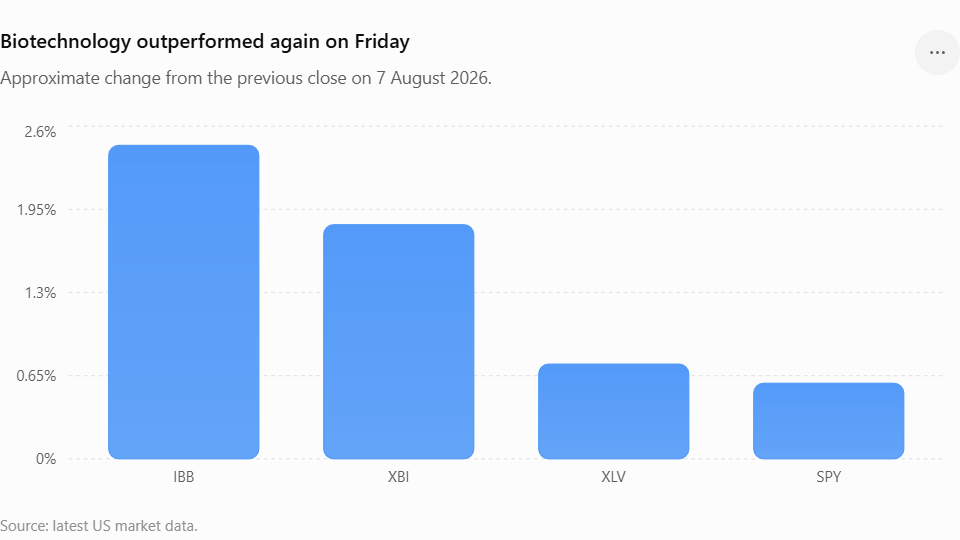
Biotechnology outperformed again on Friday. IBB gained roughly 2.45%, XBI approximately 1.83%, versus about 0.59% for the S&P 500.
The move followed surprisingly weak US employment data, which reduced expectations of another Federal Reserve rate increase. The next major test is US inflation data.
What I find Interesting
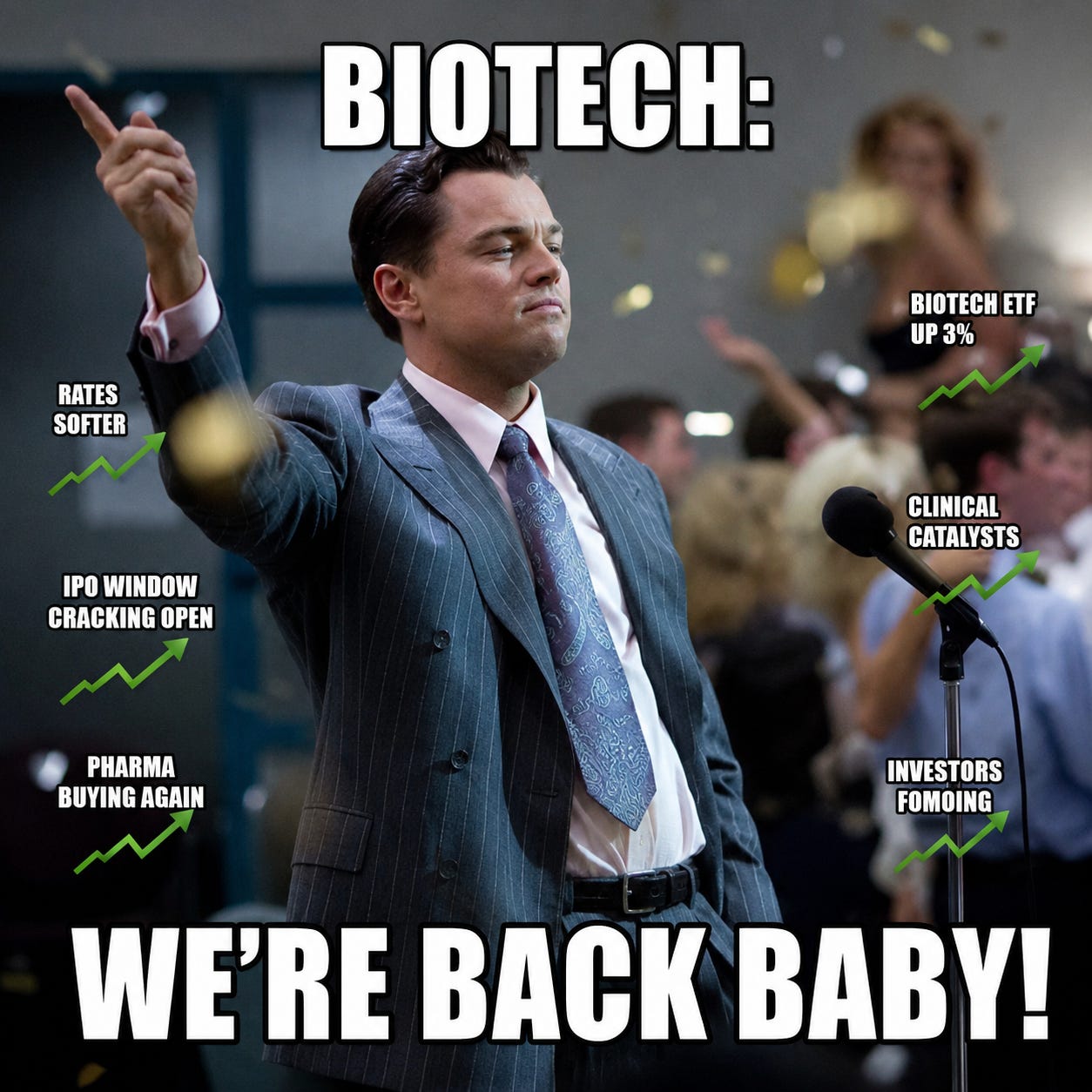
I wouldn’t say biotech is back (or at least not yet) but something more interesting may be happening. The transmission mechanism that finances biotech is beginning to reconnect.
Public valuations are recovering.
The IPO window is opening selectively.
Pharma has a very real pipeline problem, with patent cliffs forcing strategic buyers back into M&A.
And weaker employment data may finally be taking some pressure off the cost of capital.
But these are not the same signal. A biotech ETF rally doesn’t mean an early-stage company can raise its next round and a handful of successful IPOs doesn’t mean the IPO market is open to everyone. And (seriously), pharma buying assets because it needs to replace lost revenue tells us more about pharma’s balance sheet than it does about venture fundraising. The question is whether these separate developments begin to feed into one another.
M&A creates exits. Exits create distributions. Distributions improve venture fund DPI. Better DPI gives LPs a reason (and the all-very-important liquidity) to recommit. And eventually, that capital finds its way back to the companies at the beginning of the cycle.
That is the part I’m watching. Because a good week for biotech stocks is interesting but a functioning transmission mechanism from public markets back into venture capital is something much bigger (and more interesting).