


Five developments I’m watching today: record investment into women’s health but a persistent Series A bottleneck, another USD 100 million flowing into AI-enabled drug discovery, an FDA rejection that shows why manufacturing is part of the biotech asset, menopause moving deeper into neurology, and healthcare continuing to outperform the broader market
1. Women’s health investment hit a record but Series A remains the bottleneck
Women’s health companies attracted a record USD 1.55 billion of disclosed equity investment in 2025, up 41% from USD 1.1 billion in 2024, according to W Group’s first Global Women’s Health Investment Report. The capital was spread across 85 companies and more than 30 countries.
But there is a more interesting number underneath the headline.
Around 35–40 women’s health companies raise pre-seed or seed rounds each year, while only 20–25 progress to Series A. So while more capital is entering the sector, there remains a visible financing bottleneck between early validation and institutional scale. Read More
What I find Interesting
The USD 1.55 billion headline is encouraging. Regarding the drop from seed to Series A, I’d love to offer a nuanced view and somewhat controversial opinion. Not every seed company should raise a Series A. Venture capital is supposed to be selective.
The question I am keen to understand is simple:
Are good women’s health companies that have achieved the milestones we would normally expect at Series A struggling to raise capital at a higher rate than comparable healthcare companies? If the answer is yes, we have a financing gap.
If the answer is no, what we may actually be seeing is something else: company formation in women’s health growing faster than the number of companies ready for institutional capital.
Those are two very different diagnoses and they require very different solutions.
2. Another USD 100 million flows into AI-enabled drug discovery
Aureka Biotechnologies announced a USD 100 million Series B yesterday, bringing the company’s total funding to nearly USD 200 million.
Aureka combines AI with high-throughput biological experimentation to discover protein therapeutics and describes its ambition as building a “biological world model” for drug discovery.
The distinction here is important: this is not simply a software company applying AI to existing biological data. Aureka combines computational models with its own experimental infrastructure and data generation.
What I find Interesting
There is so much capital going into AI drug discovery that I increasingly think the question “How good is the AI?” is the wrong first question.
Nowadays, even asking whether the company has proprietary data may not be enough. I think the real question is whether that proprietary system produces better drugs, faster or with a higher probability of success.
A closed-loop wet lab, proprietary biological data and an AI model may be difficult to replicate. But complexity isn’t the same thing as competitive advantage.
Eventually the platform has to demonstrate that it changes the economics of drug discovery.
Does it improve hit rates? Reduce optimisation cycles? Identify targets others miss? Increase the probability that a molecule survives the clinic?
And then there is another question I find particularly interesting: if the system discovers a successful drug, where does the value actually sit? in the platform or in the molecule? That distinction matters enormously when deciding whether an AI drug-discovery company deserves a platform valuation.
3. The FDA rejected a promising radiopharmaceutical because of manufacturing
The FDA has issued ITM Isotope Technologies Munich a Complete Response Letter for ¹⁷⁷Lu-edotreotide (ITM-11), its investigational radiopharmaceutical treatment for gastroenteropancreatic neuroendocrine tumours.
What makes the rejection particularly interesting is what the FDA didn’t object to.
The agency identified no concerns with the clinical or nonclinical data package or the therapy’s safety profile. Instead, it cited Chemistry, Manufacturing and Controls (CMC) issues and matters relating to a third-party commercial manufacturing facility that must be addressed before approval.
That is notable because the Phase 3 COMPETE trial had reported median progression-free survival of 23.9 months with ¹⁷⁷Lu-edotreotide versus 14.1 months with everolimus. Read More.
What I find Interesting
We tend to think about biotech risk in terms of the science: Does the drug work? Is it safe? Will the trial succeed? Well…here, apparently, the clinical package wasn’t the problem. It was manufacturing.
That is a risk. But I think there is another way to look at it.
The thing that makes a modality difficult to manufacture can also be the thing that makes a successful company difficult to compete with.
Radiopharmaceuticals require isotope supply, specialised facilities, quality systems and time-sensitive logistics. Those look like operational complications when they go wrong. When they work, they can become infrastructure competitors cannot easily reproduce.
So “Can this drug be manufactured reliably at scale?” isn’t simply a diligence question. It may be part of the moat.
The investment question therefore becomes not only whether management has solved the manufacturing problem, but whether solving it creates an advantage that compounds across the rest of the pipeline.
4. Menopause is moving into neurology but the evidence is still remarkably thin
A new roadmap published yesterday in Nature Reviews Neurology argues that menopause remains significantly under-recognised as a contributor to brain health and that our understanding of how the menopausal transition interacts with neurological disease remains limited.
Earlier menopause has been associated with a greater risk of cognitive decline, but researchers say it remains unclear how the menopausal transition affects the subsequent risk or progression of specific neurological conditions.
The authors identify major gaps in research and call for greater investigation into the relationship between menopause, the brain and neurological disease. Read More
What I find Interesting
The more we learn about menopause, the clearer it becomes that its effects extend well beyond hot flushes and reproductive symptoms. But I think investors need to be careful with the next leap.
A biological relationship does not automatically create an investment category. If menopause is associated with changes in neurological risk, I want to know what that knowledge allows us to do differently.
Can we identify a subgroup of women earlier?
Does it change how a disease is diagnosed?
Does it reveal a therapeutic target?
Does treatment during the menopausal transition alter the subsequent neurological outcome?
Until we can answer questions like those, we may have important science without an investable intervention. And I think that distinction is particularly important in women’s health right now.
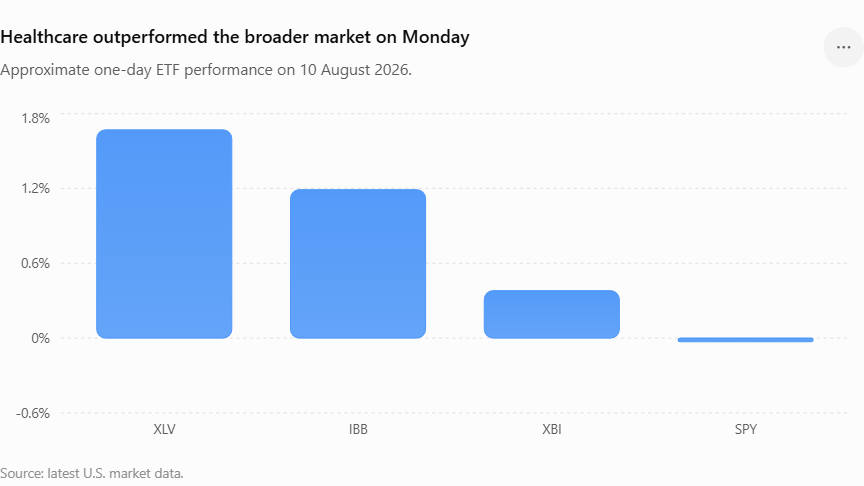
5. Healthcare outperformed again but I wouldn't make the Fed the investment thesis
Healthcare had another strong session yesterday.
The Health Care Select Sector SPDR Fund (XLV) closed 1.67% higher, while the iShares Biotechnology ETF (IBB) also advanced.

What I find Interesting
That continues the healthcare rotation we have been watching over recent weeks, alongside stronger biotech financing, increased M&A activity and improving investor appetite for the sector.
The next major macro test comes tomorrow with US inflation data, which will influence expectations for the Federal Reserve and, by extension, the discount-rate environment facing long-duration assets such as biotechnology.