

Congratulations on the breakthrough. Now what?
I went looking for the people changing healthcare for women. We ended up talking about all the things that have to happen after the exciting bit.
There is a point in my conversation with Rute Fernandes where the promising healthcare company in my head runs into a fairly substantial problem. It has done the science, met its clinical endpoints and things are looking good.
But then, the people who are supposed to pay for the treatment look at the evidence and decide it hasn’t shown them what they need to see.
Urrgh!
All that work, and the company may still struggle to get its treatment to patients. Just because somewhere along the way, “does this work?” and “will a healthcare system pay for this?” turned out to require different answers.
I had asked Rute what it takes to turn a promising scientific insight into healthcare that reaches people…. Which sounds like one question, but apparently, it is several careers’ worth of questions wearing a coat.
Rute has spent more than 25 years across pharma and healthcare, including many years in rare disease. She knows the territory between an exciting result and a patient actually receiving treatment. And there is a lot of territory.
It takes hours each week to research, write, and produce at this level. Consider becoming a free or paid subscriber to support my work. Thank you.
I wanted to make this documentary Inside Women’s Health because I spend so much time talking about the opportunity in this sector that I wanted to get closer to the work itself - the people, their decisions, what they are trying to change and what keeps getting in the way.
We have become quite good at describing the gaps in women’s health; the missing research, the delayed diagnoses, and all the things women have been expected to put up with. Heck! I’ve written a book about them, so I am very much including myself here.
But once you have established that something needs to change… well. Someone has to change it. So I took my questions to Rute, and then to Professor Carolin Lerchenmüller at the University of Zurich.
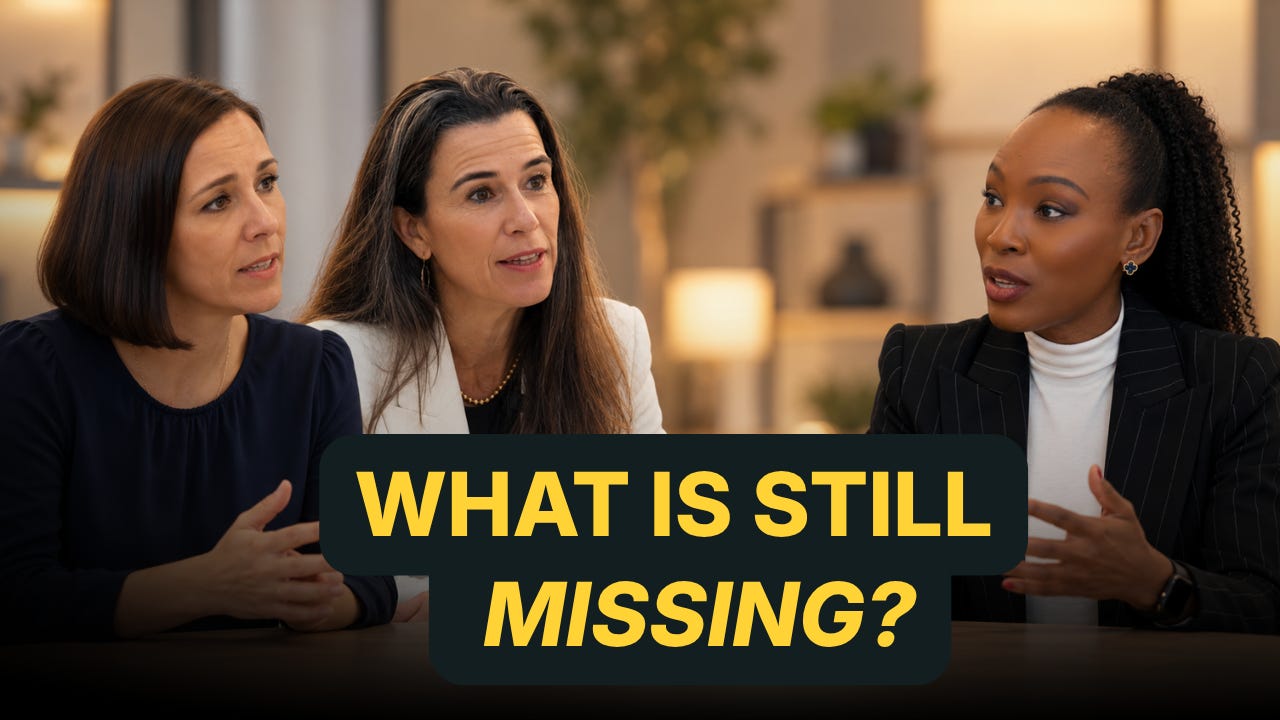
In this episode of Inside Women’s Health, I speak with healthcare operator Rute Fernandes and Professor Carolin at the University of Zurich about what it takes to turn better science into better healthcare for women from clinical evidence to reimbursement and everyday care.
With Rute, we kept coming back to the patient’s journey.
What happens when symptoms first appear?
Who recognises them?
How does someone get a diagnosis?
What treatment do they receive, and who decides?
These are things a healthcare entrepreneur needs to understand early before the commercial model becomes a slightly uncomfortable conversation everyone wishes they’d had two years ago.
And Rute insists that the patient needs to be involved in that understanding early enough to influence what gets built and what the company sets out to prove. It sounds obvious written down. A surprising number of important things do.
Later I sat with Carolin to talk about gender medicine: how biological sex and gender influence health and disease, and what a better understanding of those influences could mean for care.
At one point, she described a patient who come to her in her role as a clinical cardiologist with stomach pain. She had already seen several doctors including a gastroenterologist and was still searching for an explanation as something didn’t still feel quite right.
Carolin is a cardiologist trained on sex and gender medicine. By listening carefully and asking pointed questions, she recognised something that pointed to coronary artery disease.
She was careful to explain that the doctors this patient had seen had meant well. She wasn’t interested in blaming them. Rather she was demonstrating that the information on how sex and gender can influence health and disease still has room to travel.
I kept thinking about that because if you spend enough time in women’s health, you hear certain examples of misdiagnosis or delayed diagnosis so often that you mentally file them under surely we all know this by now. But perhaps we still don’t.
Or perhaps some of us do know, but that knowledge still has a considerable journey ahead of it before it helps the woman sitting in the next consulting room.
Towards the end of our conversation, I asked Carolin what medicine would look like if her field succeeded in becoming part of everyday practice. She talked about it becoming more personal. About wanting, as a patient herself, to be recognised as a whole person.
After all our discussion about research, guidelines and education, we had arrived back at something very familiar. Sitting opposite someone while being unwell and hoping they understand enough about you to actually help you. That is where all this work has to arrive.
Watch Inside Women’s Health on YouTube.
My new book, The Billion Dollar Blindspot is now available on Amazon and in bookstores.

About Maryann Selfe
Maryann Selfe is an institutional investor and the Founder and Chief Investment Officer of Calabar Capital, an investment platform backing exceptional managers and founders in women’s health. She is the author of The Billion Dollar Blindspot and writes about women’s-health investing and capital allocation.
Connect on LinkedIn · Discover the Book · Learn more about Calabar Capital
The Billion Dollar Blindspot is an independent publication. Its content is provided for informational and educational purposes only and does not constitute financial advice, an investment recommendation or an offer to buy or sell any security.